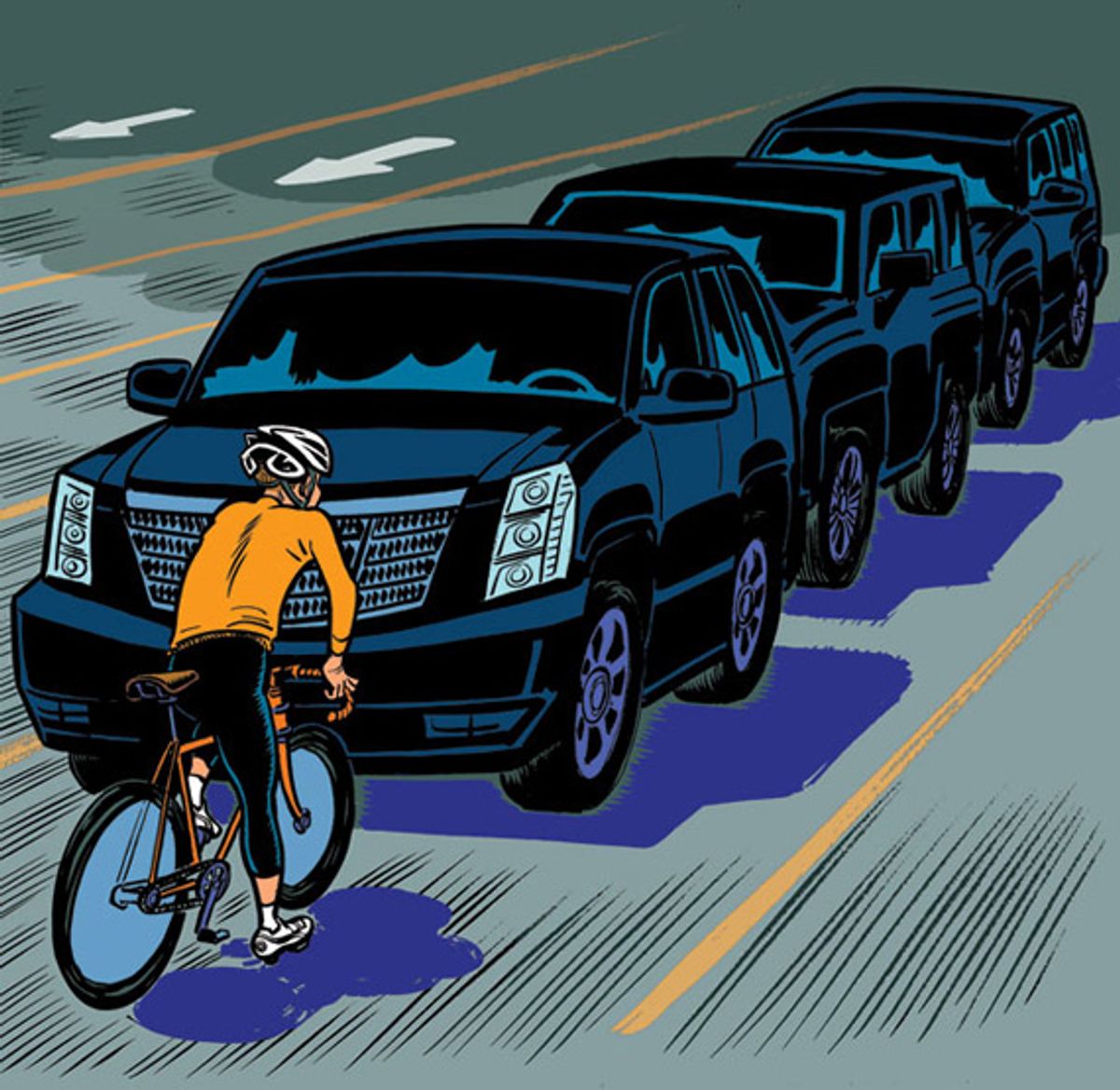
A specter is haunting Seattle—the specter of a War on Cars. All the powers of Old Seattle have entered into a “holy” alliance to win this war: Seattle Times publisher and city council president, columnist Joni Balter and developer Kemper Freeman, Rainier Club regulars and suburban slobs.
Where is the advocate for increased bike and pedestrian safety who has not been branded an anti-car “militant”? Where is the politico who has not used the “War on Cars” rubric as a tool for demonizing the nondriving classes, for marginalizing our city’s walkers, bike riders, and mass transit users?
The mindless repetition of this “War on Cars” falsehood—by car advocates harboring a phony, self-serving sense of victimhood—has led to a situation in which this “War on Cars” is acknowledged by most Seattleites to be real. Because of this regrettable specter, it is high time that cyclists, pedestrians, and their transit-riding comrades openly publish their views, their aims, their tendencies, and meet this nursery tale of a “War on Cars” with a manifesto of and by the nondrivers themselves:
I. The car-driving class must pay its own way!
For cars we have paved our forests, spanned our lakes, and burrowed under our cities. Yet drivers throw tantrums at the painting of a mere bicycle lane on the street. They balk at the mere suggestion of hiking a car-tab fee, raising the gas tax, or tolling to help pay for their insatiable demands, even as downtrodden transit riders have seen fares rise 80 percent over four years.
No more! We demand that car drivers pay their own way, bearing the full cost of the automobile-petroleum-industrial complex that has depleted our environment, strangled our cities, and drawn our nation into foreign wars. Reinstate the progressive motor vehicle excise tax, hike the gas tax, and toll every freeway, bridge, and neighborhood street until the true cost of driving lies as heavy and noxious as our smog-laden air. Our present system of hidden subsidies is the opiate of the car-driving masses; only when it is totally withdrawn will our road-building addiction finally be broken.
II. All power to the people’s transit
If Seattle is to become a people’s paradise, our buses, rail, streetcars, and ferries must stretch into every neighborhood, running reliably, affordably, and at all hours of the day and night. Since mass transit serves the masses, the mass of our transportation dollars must hereafter be spent to meet its needs.
III. The pedestrian and bicycle classes must be protected. And served!
The history of transportation is the history of struggle between the drivers and the nondrivers whose lives and limbs have literally been crushed. Between 2000 and 2009 in King County, 19 cyclists and 238 pedestrians lost their lives to cars, while injuries sent another 423 cyclists and 1,656 pedestrians to our hospital wards for two days or more after being hit by cars. If there is, in fact, a “War on Cars,” then the cars are winning—as a look at recent headlines confirms. Saturday, September 10, brought the death of a young cyclist in the University District, and Sunday, September 11, brought the death of a woman biking on the Olympic Peninsula while wearing a helmet and a bright protective vest. Both were killed in collisions with cars.
The bikers and walkers, which neither slurp government dollars nor consume natural resources at the pace of the drivers, demand safer streets and sidewalks. As the Economist suggested on September 3 when responding to Seattle’s spate of recent cyclist deaths, cars on streets with bike lanes must be subjected to “traffic calming” methods already used in European capitals like Amsterdam, Copenhagen, and Portland. When cars must slow down below 20 miles per hour, they kill less than 5 percent of collision victims. And the busiest bike lanes must be physically protected from the four-wheeled instruments of death through concrete buffers, rows of trees, or other barriers. In some places, whole streets—yes, whole streets, we have plenty to spare—must be closed to cars, creating bike and pedestrian malls and paths of the kind found throughout more forward-thinking, class-conscious cities.
We make these demands because, unfortunately, we must. Our epoch, the epoch of the car, possesses this distinct feature: It has created a simplified antagonism. Seattle as a whole is now more and more splitting up into two great hostile camps, into two great classes directly fighting each other—car driver and nondriver.
This antagonism traces directly to the creation of the modern car driver, a privileged individual who, as noted, is the beneficiary of a long course of subsidies, tax incentives, and wars for cheap oil. But the same subsidies that created this creature (who now rages about the roads while simultaneously screaming of being a victim in some war) can—and must, beginning now—be used to build bike lanes, sidewalks, light rail, and other benefits to the nondriving classes.
“A Manifesto: We Fight Because We Must” opens “Okay, Fine, It’s War”, a feature the Seattle weekly The Stranger published on 14 September 2011, days after two more cyclists were killed in collisions with cars. Answering local politicians and commentators who accused bike and transit advocates of waging a “War on Cars”, the paper’s staff wrote a manifesto “of and by the nondrivers themselves”, deliberately modelled on the opening of The Communist Manifesto (“A specter is haunting Seattle…”).
Its three demands are that drivers pay the full cost of driving through taxes and tolls, that transit reach every neighbourhood at all hours, and that pedestrians and cyclists get traffic calming, physically protected bike lanes and car-free streets. The rest of the feature reported on recent deaths, rising collision numbers and Seattle’s transport spending. Streetsblog and Grist picked the piece up within days.