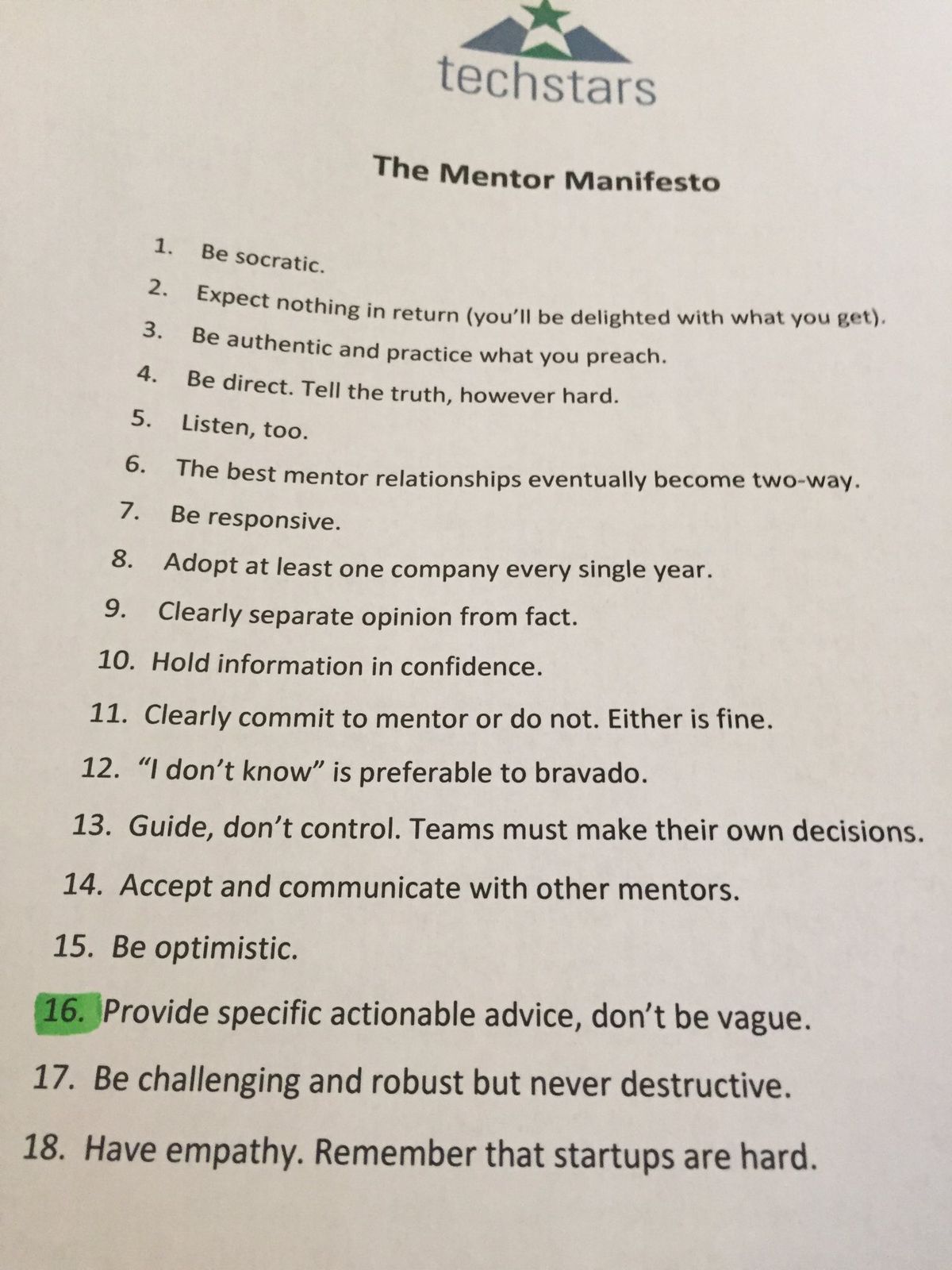
Based on our experience of mentoring and being mentored, and in order to help guide the many mentors who volunteer their time to help entrepreneurs and startups succeed, we composed this Mentor Manifesto.
Be socratic.
Expect nothing in return (you’ll be delighted with what you do get back).
Be authentic / practice what you preach.
Be direct. Tell the truth, however hard.
Listen too.
The best mentor relationships eventually become two way.
Be responsive.
Adopt at least one company every single year. Experience counts.
Clearly separate opinion from fact.
Hold information in confidence.
Clearly commit to mentor or do not. Either is fine.
Know what you don’t know. Say I don’t know when you don’t know. “I don’t know” is preferable to bravado.
Guide, don’t control. Teams must make their own decisions. Guide but never tell them what to do. Understand that it’s their company, not yours.
Accept and communicate with other mentors that get involved.
Be optimistic.
Provide specific actionable advice, don’t be vague.
Be challenging/robust but never destructive.
Have empathy. Remember that startups are hard.
The Mentor Manifesto is a list of 18 rules for how to mentor startup founders. Techstars co-founder David Cohen wrote it with Jon Bradford and Brad Feld and first posted it on his blog in August 2011, as a draft that readers could comment on. Techstars adopted it as the code of conduct for the volunteer mentors in its accelerator programmes, handed it out on paper at programme events, and Brad Feld later wrote a blog post on each of its 18 points.
The wording has shifted between versions: the text here follows the version on the Techstars site, while the printed handout shortens some lines (“Be authentic and practice what you preach”, “Accept and communicate with other mentors”).