Blessed are the poor in spirit: for theirs is the kingdom of heaven.
Blessed are they that mourn: for they shall be comforted.
Blessed are the meek: for they shall inherit the earth.
Blessed are they which do hunger and thirst after righteousness: for they shall be filled.
Blessed are the merciful: for they shall obtain mercy.
Blessed are the pure in heart: for they shall see God.
Blessed are the peacemakers: for they shall be called the children of God.
Blessed are they which are persecuted for righteousness’ sake: for theirs is the kingdom of heaven.
Blessed are ye, when men shall revile you, and persecute you, and shall say all manner of evil against you falsely, for my sake.
Rejoice, and be exceeding glad: for great is your reward in heaven: for so persecuted they the prophets which were before you.
Ye are the salt of the earth: but if the salt have lost his savour, wherewith shall it be salted? it is thenceforth good for nothing, but to be cast out, and to be trodden under foot of men.
Ye are the light of the world. A city that is set on an hill cannot be hid.
Neither do men light a candle, and put it under a bushel, but on a candlestick; and it giveth light unto all that are in the house.
Let your light so shine before men, that they may see your good works, and glorify your Father which is in heaven.
Matthew 5:3–16, the opening of the Sermon on the Mount, King James Version (1611; public domain, text as in Project Gutenberg eBook #10).
The Bible is the collection of sacred texts of Judaism and Christianity: the Hebrew Bible (the Christian Old Testament) and, for Christians, the New Testament. Its books were written, edited and compiled in Hebrew, Aramaic and Greek by many mostly anonymous authors over roughly a thousand years, from perhaps as early as 1200 BC (its oldest parts) to the first century AD, when most of the New Testament was written. It is the best-selling publication of all time, and its laws, stories and moral teachings have shaped religion, law, art, literature and politics around the world.
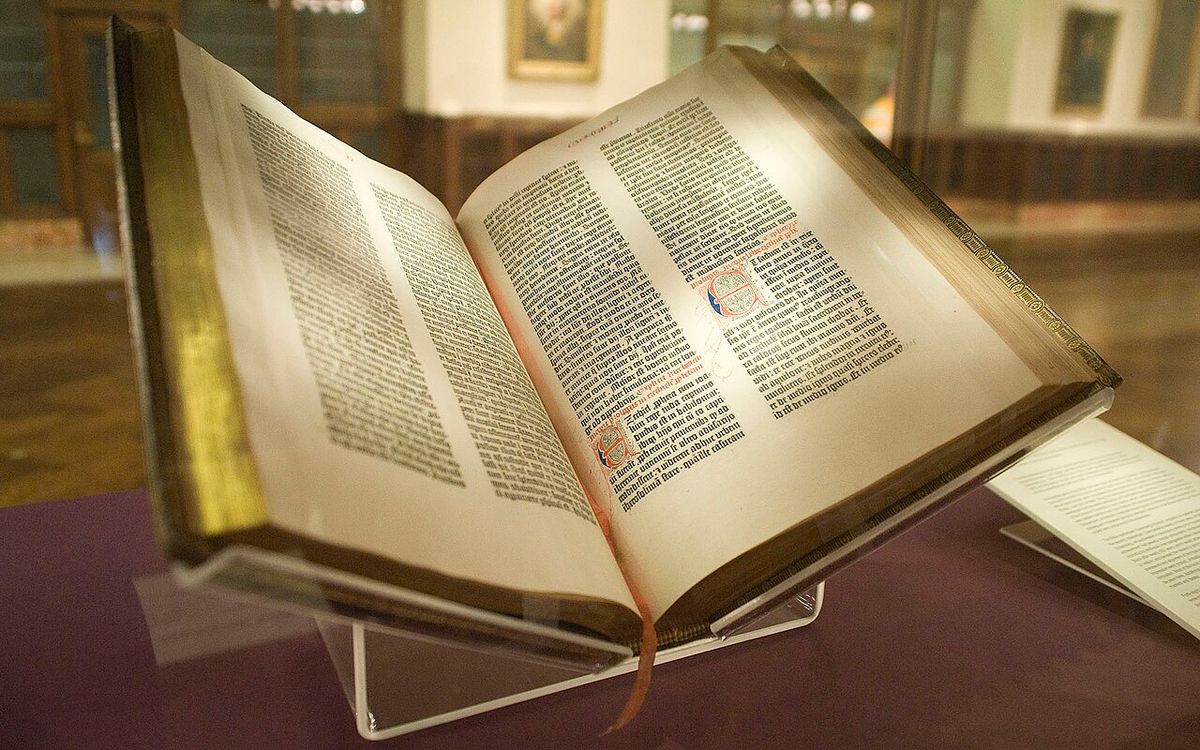
The Bible is far too long to reproduce here, so the text shown is the passage that most works as a manifesto: the Beatitudes and the “salt of the earth” and “light of the world” sayings that open Jesus’s Sermon on the Mount (Matthew 5:3–16), in the King James Version. The Ten Commandments and the Genesis creation narrative have entries of their own. The image shows the Gutenberg Bible (c. 1455), the first major book printed with movable type in Europe.