1. Every good work of software starts by scratching a developer’s personal itch.
2. Good programmers know what to write. Great ones know what to rewrite (and reuse).
3. “Plan to throw one away; you will, anyhow.” (Fred Brooks, The Mythical Man-Month, Chapter 11)
4. If you have the right attitude, interesting problems will find you.
5. When you lose interest in a program, your last duty to it is to hand it off to a competent successor.
6. Treating your users as co-developers is your least-hassle route to rapid code improvement and effective debugging.
7. Release early. Release often. And listen to your customers.
8. Given a large enough beta-tester and co-developer base, almost every problem will be characterized quickly and the fix obvious to someone.
9. Smart data structures and dumb code works a lot better than the other way around.
10. If you treat your beta-testers as if they’re your most valuable resource, they will respond by becoming your most valuable resource.
11. The next best thing to having good ideas is recognizing good ideas from your users. Sometimes the latter is better.
12. Often, the most striking and innovative solutions come from realizing that your concept of the problem was wrong.
13. “Perfection (in design) is achieved not when there is nothing more to add, but rather when there is nothing more to take away.”
14. Any tool should be useful in the expected way, but a truly great tool lends itself to uses you never expected.
15. When writing gateway software of any kind, take pains to disturb the data stream as little as possible—and never throw away information unless the recipient forces you to!
16. When your language is nowhere near Turing-complete, syntactic sugar can be your friend.
17. A security system is only as secure as its secret. Beware of pseudo-secrets.
18. To solve an interesting problem, start by finding a problem that is interesting to you.
19. Provided the development coordinator has a communications medium at least as good as the Internet, and knows how to lead without coercion, many heads are inevitably better than one.
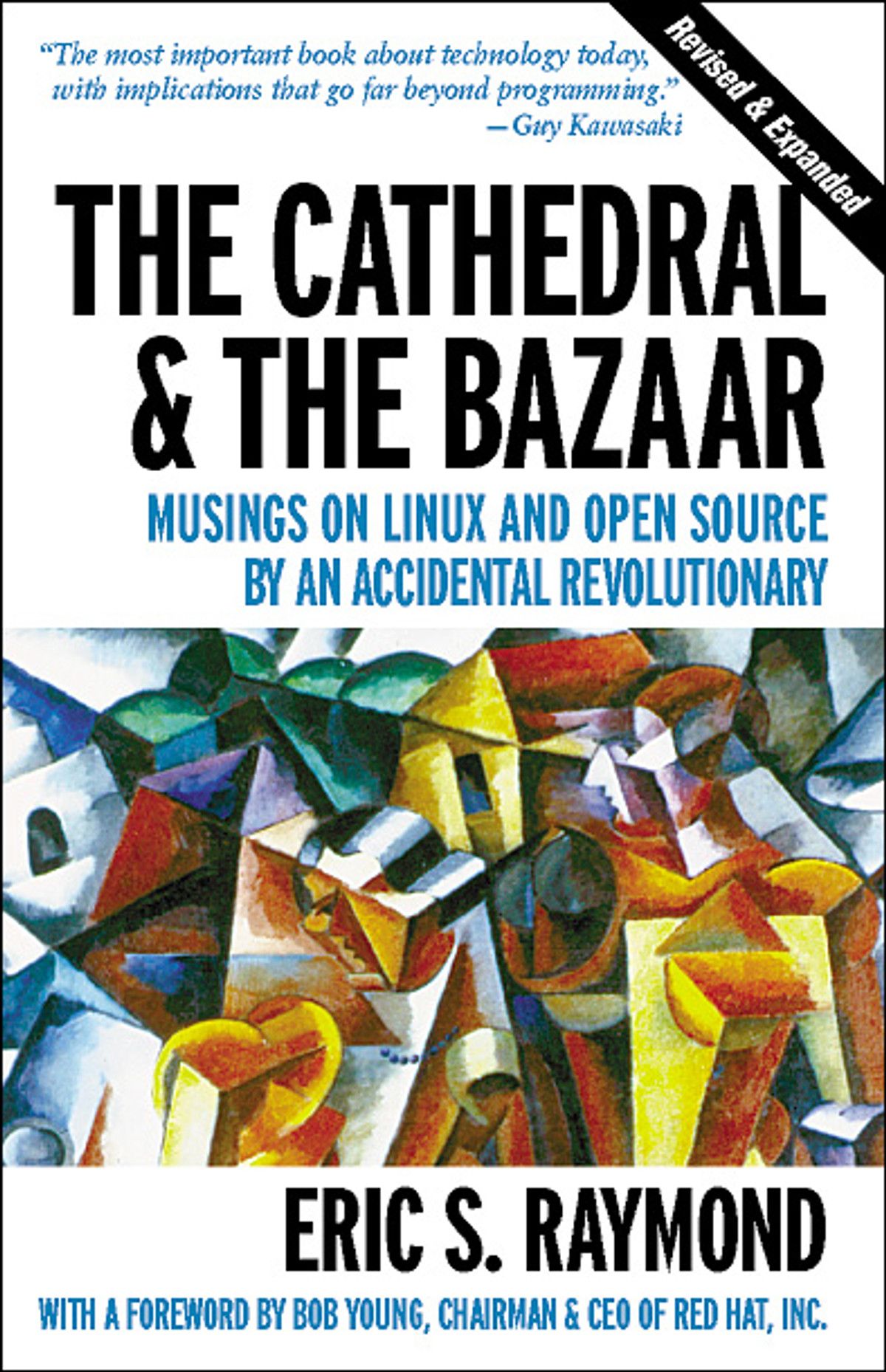
Eric S. Raymond’s essay on open-source software development, first presented at the Linux Kongress in Würzburg, Germany, in May 1997 (Raymond’s revision history dates the presentation to 21 May; other accounts give 27 May). Drawing on his own fetchmail project and on Linus Torvalds’s way of running Linux, it contrasts two models of building software: the “cathedral”, carefully crafted by a small closed group and released only when finished, and the “bazaar”, developed in public over the Internet with users treated as co-developers. Its best-known line, “given enough eyeballs, all bugs are shallow”, Raymond named Linus’s Law.
The essay helped persuade Netscape to release the source code of its browser in 1998, the project that became Mozilla, and was a founding text of the open source movement. O’Reilly published it as a book in 1999, with a revised edition in 2001, and Raymond keeps the text freely available under the Open Publication License. The text below is the nineteen lessons Raymond draws out across the essay.