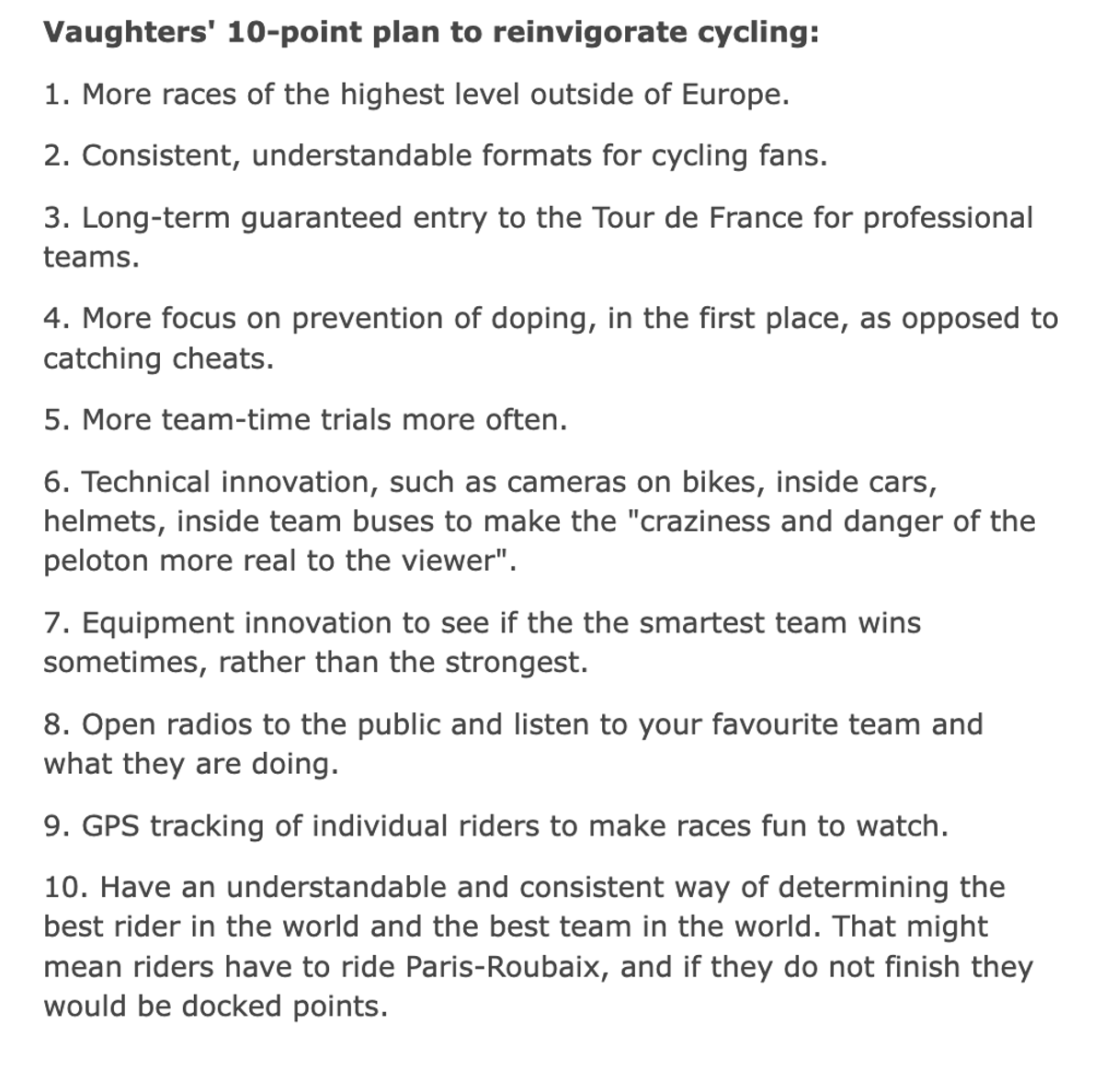
1. More races of the highest level outside of Europe.
2. Consistent, understandable formats for cycling fans.
3. Long-term guaranteed entry to the Tour de France for professional teams.
4. More focus on prevention of doping, in the first place, as opposed to catching cheats.
5. More team-time trials more often.
6. Technical innovation, such as cameras on bikes, inside cars, helmets, inside team buses to make the "craziness and danger of the peloton more real to the viewer".
7. Equipment innovation to see if the the smartest team wins sometimes, rather than the strongest.
8. Open radios to the public and listen to your favourite team and what they are doing.
9. GPS tracking of individual riders to make races fun to watch.
10. Have an understandable and consistent way of determining the best rider in the world and the best team in the world. That might mean riders have to ride Paris-Roubaix, and if they do not finish they would be docked points.
In March 2011 Jonathan Vaughters, director of the Garmin-Cervélo team and president of the professional teams’ association AIGCP, gave BBC Sport a ten-point plan to rebrand professional road cycling, arguing that the sport “should be on the level of Premier Football”. It called for more top races outside Europe, consistent formats fans can follow, long-term guaranteed Tour de France places for teams, a focus on preventing rather than only catching doping, more team time trials, on-bike and in-car cameras, equipment innovation, open team radio, GPS rider tracking and a clear ranking of the best rider and team.
Alongside the plan Vaughters proposed that teams donate 20% of new money to anti-doping in return for guaranteed Tour entry for five, ten or fifteen years, and criticised the UCI’s governance: “My ability to vote on any regulation is essentially nil.” It came amid the teams’ dispute with the UCI over its ban on race radios.