Repair Manifesto
We hold these truths to be self-evident
If you can’t fix it, you don’t own it.
Repair is better than recycling
Making our things last longer is both more efficient and more cost-effective than mining them for raw materials.
Repair saves you money
Fixing things is often free, and usually cheaper than replacing them. Doing the repair yourself saves you money.
Repair teaches engineering
The best way to find out how something works is to take it apart.
Repair saves the planet
Earth has limited resources. Eventually we will run out. The best way to be efficient is to reuse what we already have.
Repair connects people and things
Repair is war on entropy
Repair is sustainable
We have the right:
To devices that can be opened
To repair documentation for everything
To repair things in the privacy of our own homes
To error codes & wiring diagrams
To choose our own repair technician
To non-proprietary fasteners
To remove ‘do not remove’ stickers
To replace any & all consumables ourselves
To troubleshooting instructions & flowcharts
To available, reasonably-priced service parts
Because repair
is independence
saves money & resources
requires creativity
makes consumers into contributors
inspires pride in ownership
Join the revolution with ifixit.com
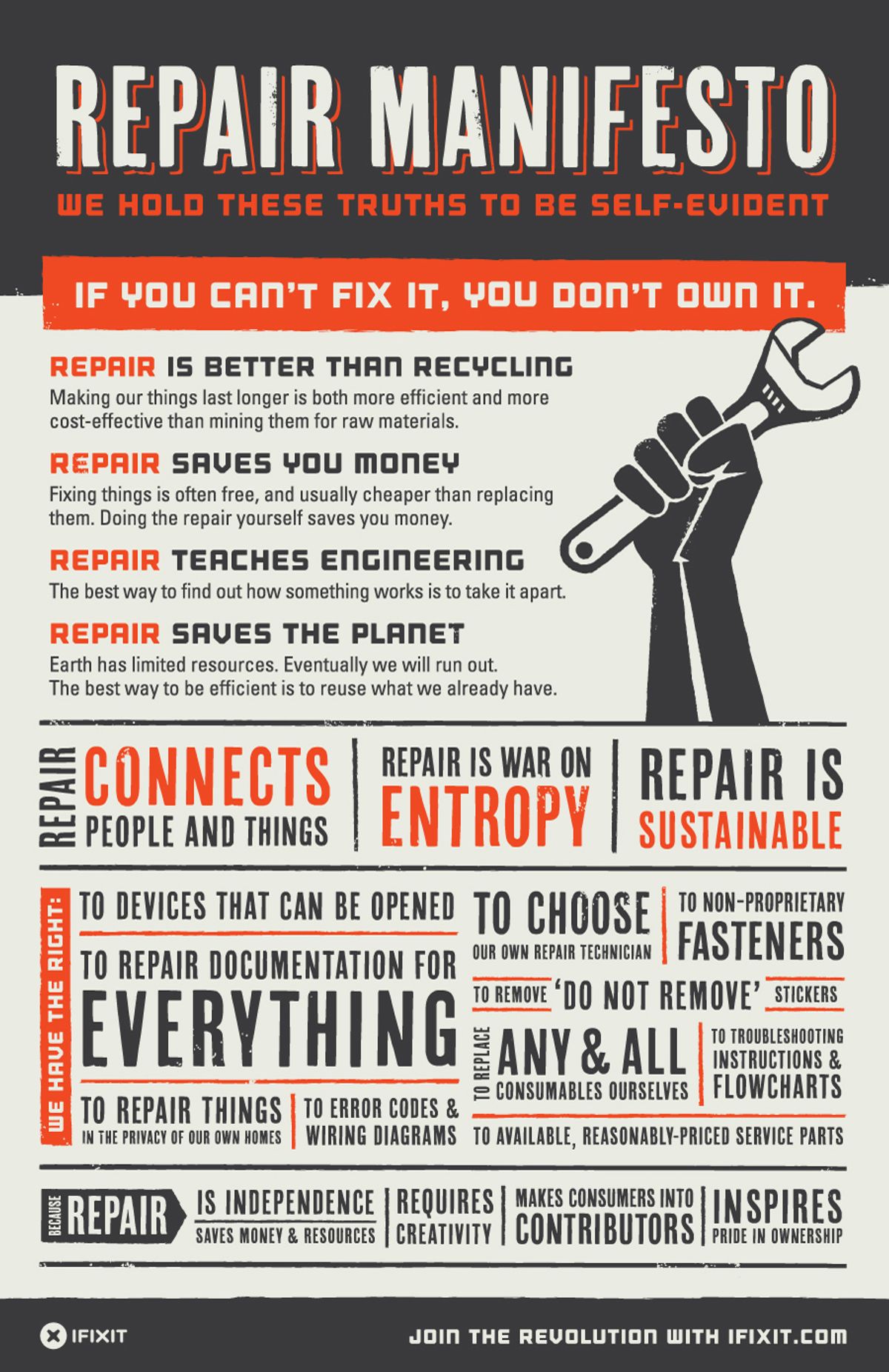
The Self-Repair Manifesto is a poster published by iFixit, the online repair community and free repair manual, in November 2010. iFixit co-founder Kyle Wiens posted it as a call to action asking people to insist that everything they buy can be repaired, and the company mailed printed posters to workshops, hackerspaces and garages and released the file under a Creative Commons licence so anyone could print, hack and redistribute it.
Headed “Repair Manifesto” and opening with “We hold these truths to be self-evident”, it borrows the language of the US Declaration of Independence. Its slogan, “If you can’t fix it, you don’t own it”, became a rallying cry of the right-to-repair movement, and the list of rights it claims (repair documentation, non-proprietary fasteners, reasonably priced parts) anticipates the demands of later right-to-repair laws.