Brilliant cities are globally renowned for being prosperous and highly liveable. They allow residents to live close to where they work, and enjoy housing security and easy access to services, amenities and open space. Crucially, infrastructure, services and technology are deeply integrated with people’s lives. Digital applications and the sharing economy operate around the clock, giving residents seamless on-demand access to transport and other services at any hour of the day. These technological innovations connect communities; they also enable remote work and sharing of ideas. In addition, a greater mix of housing types provides residents with more diverse, equitable and, in turn, liveable environments. Achieving this vision in Sydney will take more than just spending money. Governance, planning and procurement settings are crucial. All three tiers of government, as well as other stakeholders, must also collaborate to identify goals and prioritise funding, and they must be held accountable for delivering these commitments.
Faced with these challenges, Sydney has two options. It can continue along its current trajectory, becoming increasingly a divided city with an inequitable distribution of opportunities and amenities. Alternatively, it can seize the mantle of growth to reinvent itself as a brilliant city that offers economic opportunities to all segments of the socio-economic spectrum.
In this manifesto, AECOM proposes 10 ‘big moves’, each supported by critical implementation actions that should be considered as part of an overarching long-term plan for Sydney:
1. Evolve Sydney’s governance model: Building on the recent Greater Sydney Commission’s work of establishing a streamlined regional governance, if Sydney is to retain its global competitiveness and liveability, it is vital to deliver next-generation governance that will transform the city at the pace required. Streamlining ministerial arrangements and having a ‘Major Projects Control Board’ with high-level representation from all three tiers of government, and the private sector, would instil a common leadership purpose and create shared ownership of major projects.
2. Rethink future procurement and delivery: More flexible and varied procurement strategies are urgently needed to deliver urban infrastructure. The goal should be to move towards a ‘market capability’ model through which governments at all levels can seek knowledge and skills from the private sector to help deliver large infrastructure projects.
3. Embed a smart city approach to planning: Making technology and data work for everyone by sharing information between citizens, businesses and governments will allow planners to make more informed choices to smooth road congestion, optimise the use of public transport and locate new housing and infrastructure. Analytics and artificial intelligence will also help identify and predict needs in healthcare, education and social services.
4. Value green infrastructure: Trees, green roofs, rain gardens and other forms of green infrastructure should be recognised and integrated into city planning, based on a comprehensive accounting of their benefits and costs. Specifically, green infrastructure should be recognised as an asset class by Infrastructure Australia, Infrastructure NSW and the NSW Independent Pricing and Regulatory Tribunal (IPART) and included in the state infrastructure strategy.
5. Optimise Sydney transport: A more proactive approach to operating Sydney’s transport network will balance competing demands for limited road space, and seek to efficiently use available capacity. Mobility-as-a-Service solutions, which bring together real-time service information, journey planning and payment functions across different public, private and shared transport modes, will help people make smart travel choices.
6. Deliver next-generation corridors: Next-generation corridors prioritise the movement of people, water and essential services — not just vehicles. They should be value-generating assets that attract employment and provide great places to live, work and play. New corridors should be created to connect the east and west of the city, and by leveraging existing assets such as Parramatta River.
7. Reform Sydney’s freight network: As Sydney’s population grows, it is vital to preserve corridors for future freight routes, either by road or rail. New solutions are also needed to deliver parcels and groceries efficiently. This should involve more small delivery consolidation points, incentives for CBD deliveries outside peak times, research and testing of drones and proactive planning for how drone traffic patterns will affect the city in the future.
8. Make housing more diverse and affordable: Sydney should embrace innovations to build smaller homes and use more-efficient designs and building materials. New models such as ‘build to rent’ should be introduced, diversifying options for the city’s population. A comprehensive review of tax incentives is needed. Transitioning from stamp duty to a land tax may lead to a more equitable and liquid market, and allow a better base for value capture.
9. Turn Sydney electric: Managing growing demand will require new strategies to optimise Sydney’s electricity network, and lessen strains during peak times. Distributed energy resources such as solar photovoltaic power must be integrated with the grid. A considered plan is also needed to cater for the mass uptake of electric vehicles in Sydney.
10. Create a water-sensitive city: Major reforms are needed to ensure Sydney can deliver an adequate water supply to its population. These include widespread use of smart metering, increasing capacity, creating a network of new lakes, harvesting stormwater and using potable water more wisely.
Sydney has natural beauty and world-leading attractions. The city is blessed with a thriving economy, and exciting and diverse communities. For Sydney to achieve its potential in future decades, it is vital that its leaders plan for growth, with the same boldness and imagination as previous leaders who delivered projects such as Sydney’s Cumberland Plan, the Sydney Harbour Bridge and the Sydney Opera House. It is time to make Sydney not only functional, but also brilliant.
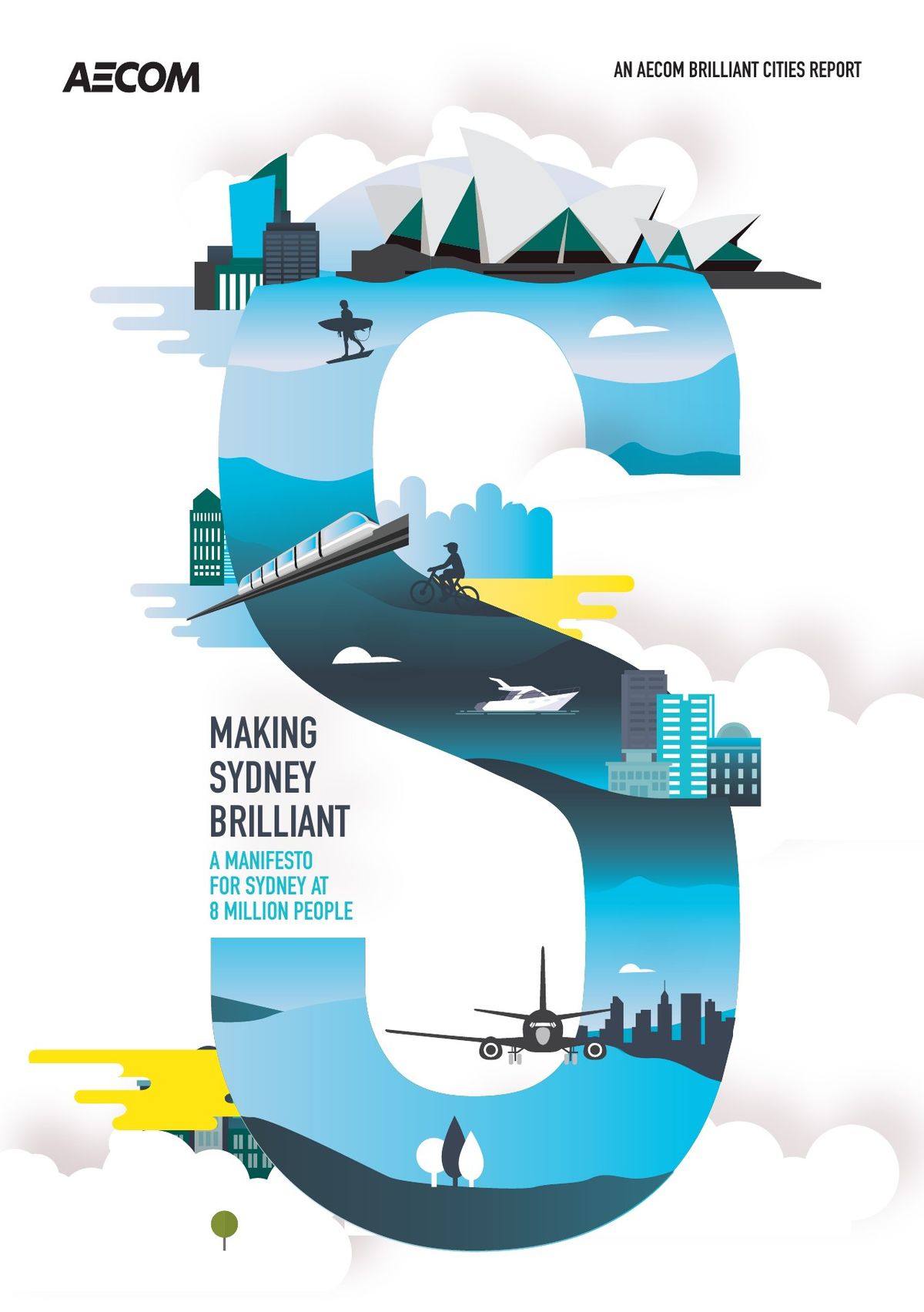
Making Sydney Brilliant: A Manifesto for Sydney at 8 Million People is a 2018 report by the global infrastructure firm AECOM, the sixth in its Brilliant Cities thought-leadership series. Written by James Rosenwax, AECOM’s Executive Director of Cities for Australia and New Zealand, it was released in June 2018 to guide business and government as Sydney’s population heads from 5 to 8 million, possibly by 2050.
It names ten trends pulling Sydney towards a divided “city of haves and have-nots”, from a housing affordability crisis and an infrastructure bottleneck to climate shocks, and answers them with ten “big moves” on governance, procurement, smart-city planning, green infrastructure, transport, corridors, freight, housing, energy and water. The text here is taken from the report’s executive summary: its vision of a brilliant city, the choice facing Sydney, the ten big moves and the closing call. The full 45-page report sets out the trends and implementation actions in detail.