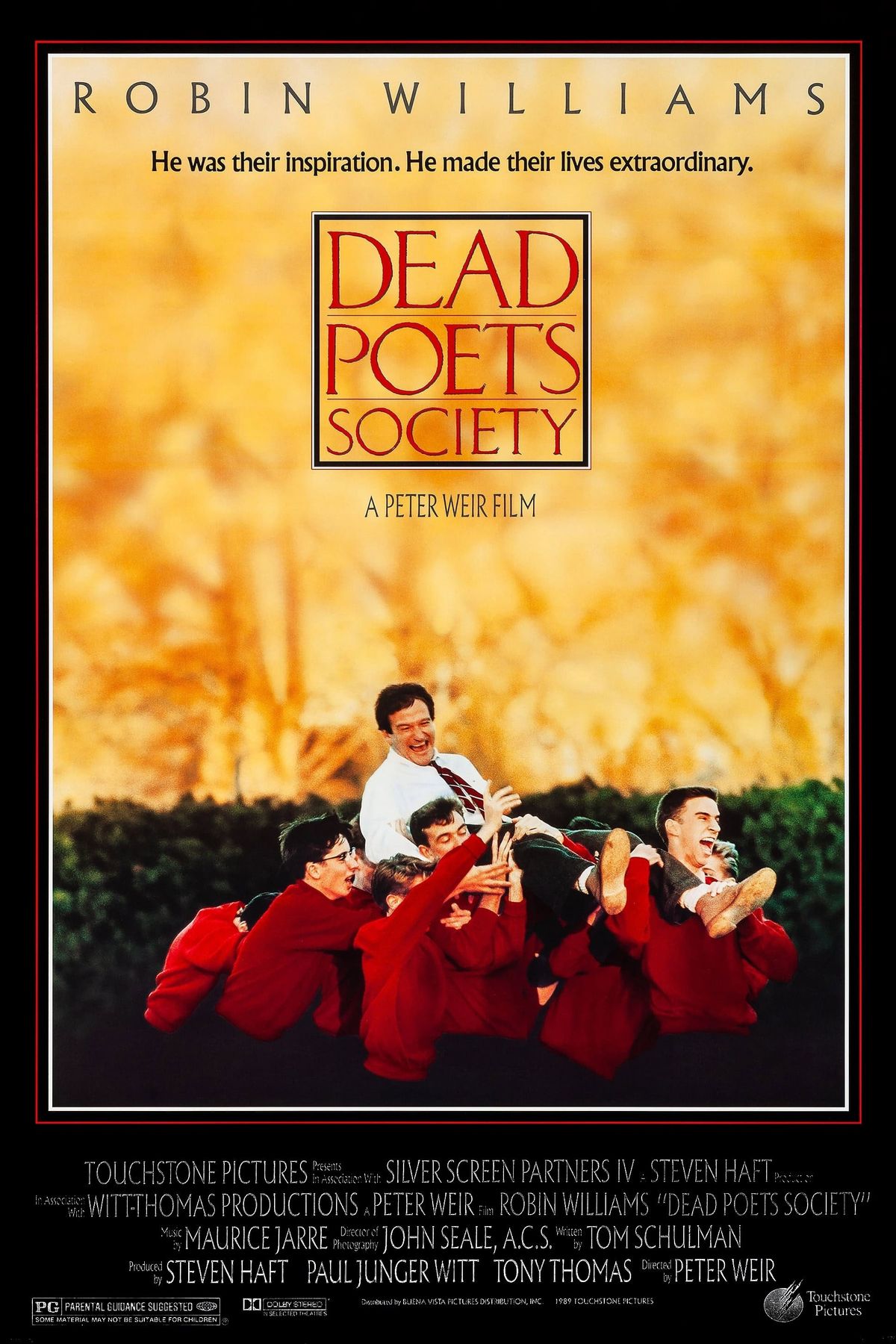
We don't read and write poetry because it's cute. We read and write poetry because we are members of the human race. And the human race is filled with passion. And medicine, law, business, engineering, these are noble pursuits and necessary to sustain life. But poetry, beauty, romance, love, these are what we stay alive for.
To quote from Whitman, “O me! O life!... of the questions of these recurring; of the endless trains of the faithless, of cities fill'd with the foolish… what good amid these, O me, O life? Answer. That you are here—that life exists, and identity, that the powerful play goes on, and you may contribute a verse.” That the powerful play goes on, and you may contribute a verse. What will your verse be?
— John Keating (Robin Williams) in Dead Poets Society (1989), written by Tom Schulman, directed by Peter Weir. Excerpt; full script linked below.
Dead Poets Society is a 1989 film directed by Peter Weir from an original screenplay by Tom Schulman, released by Touchstone Pictures, in which Robin Williams plays John Keating, an unconventional English teacher at a strict New England boarding school in 1959. Keating’s call of “carpe diem” urges his students to think for themselves and choose poetry and passion over conformity. The film opened on 2 June 1989, was nominated for four Academy Awards including Best Picture, and won Schulman the Oscar for Best Original Screenplay.
The excerpt is Keating’s classroom speech on why we read poetry, ending with Walt Whitman’s “O Me! O Life!”. Transcripts of the film differ slightly in wording (one has “these are all noble pursuits”).